Birchfell
Restoring native UK woodland for long-term carbon recovery
The story behind Birchfell.
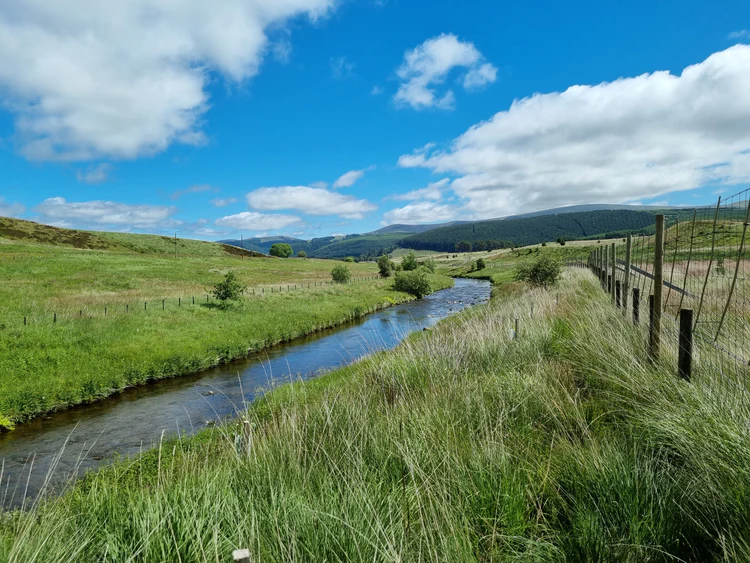
Birchfell sits in the Scottish Borders, a stretch of ground that’s been pushed hard for grazing and commercial timber. It’s now being taken in a different direction: native broadleaf woodland allowed to grow without interference. Trees go in, and then nature decides the shape of the place. That shift matters. It slows the heavy rain that normally tears through the hills, steadies the soils before they wash into the Tweed, pulls carbon out of the air, and gives back space to wildlife that’s been squeezed to the margins.
The site sits close to one of the UK’s most protected river systems. As the canopy builds, the woodland cools the river corridor, filters run-off, adds structure to the landscape, and rebuilds food chains that collapsed under agricultural pressure. In a region dominated by uniform grazing blocks and plantations, this pocket of regeneration breaks the pattern. It becomes a place where insects return, birds follow, and the ground recovers its ability to hold water and store carbon without constant human correction.
Around forty-four thousand native trees were planted in spring 2021. Over their lifetime they are expected to remove just over eleven thousand tonnes of CO₂ from the atmosphere. The gain is slow, real, and cumulative—exactly the kind of climate work that lasts.
Units from this site are PIUs - future carbon removals, not verified tonnes - so they can’t be used for neutrality or net-zero claims. They back long-term recovery, not immediate accounting needs. If you need credits that do qualify for formal claims, all our non-UK projects are fully verified and ready for retirement the moment you purchase them.
This woodland is accredited by the Woodland Carbon Code, a quality assurance standard that is backed by the UK government.

The Woodland Carbon Code is the UK's quality assurance standard for woodland creation projects. Endorsed by the UK government, it requires independent validation, long-term management plans, and ongoi ng monitoring to certify carbon sequestered by new native woodland. Projects must demonstrate additionality and are listed on the UK Land Carbon Registry, providing transparent, publicly auditable proof of verified carbon capture on British soil. …read more
Get verified and start supporting real, traceable climate projects.
Get Verified Plant TreesWhere in the world.
Pinpointing exactly where your funding makes a difference.
Explore more projects
Your funding directly supports verified projects across the globe.
Fund projects like Birchfell.
Get verified and start supporting traceable climate projects with independently audited carbon retirement.